
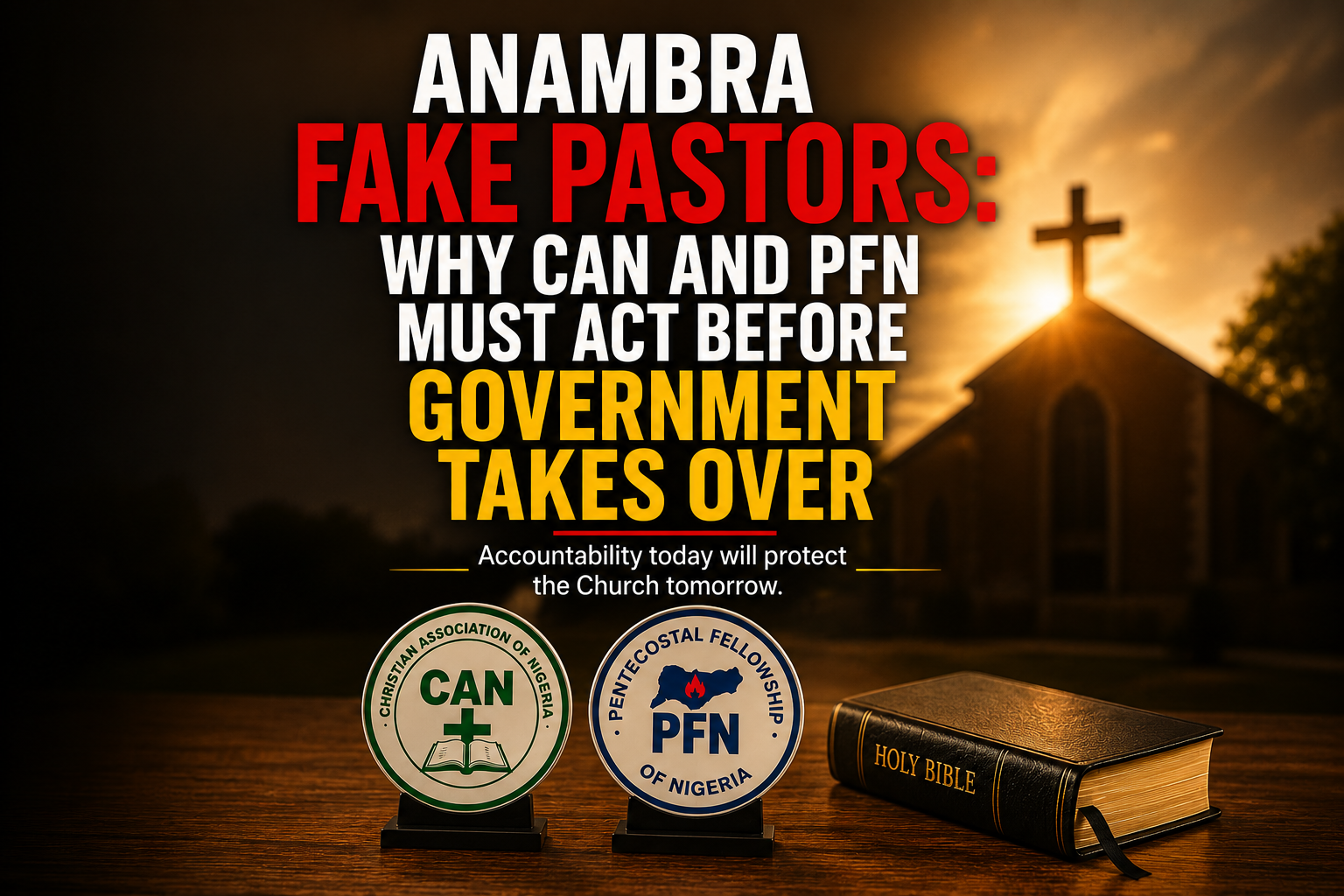
The controversy surrounding the alleged Anambra fake pastors is bigger than a criminal case. It raises uncomfortable questions about accountability, Church leadership, and whether CAN and PFN are protecting the integrity of Christianity in Nigeria.
Several alleged fake pastors have reportedly been arraigned in Anambra State. They remain innocent until proven guilty. Yet beyond the courtroom lies a deeper question the Christian Association of Nigeria and the Pentecostal Fellowship of Nigeria cannot ignore.
If CAN and PFN fail to address misconduct within the Church, will government eventually step in and do it for them? That question should concern every Christian.
Anambra and Fake Patsors. Click to read more
For years, Nigerians have heard stories about questionable prophecies, staged testimonies, miracle products, financial exploitation, and spiritual manipulation. Many sincere pastors still preach Christ faithfully. Yet the actions of a few have weakened public confidence in the Church. Anambra should be seen as a warning to the Nigerian Church.
The Anambra Fake Pastors Allegations Should Concern Every Believer
According to reports, the accused persons were arraigned for allegedly violating provisions of the Anambra Homeland Security Law. The allegations reportedly include fake prophecies, fake miracles, religious deception, exploitation of vulnerable citizens, and the sale or promotion of miracle products. Again, these remain allegations. The courts must determine the facts.
Nevertheless, this case extends beyond those standing before a judge. For decades, Nigerians have complained about spiritual abuse carried out under religion. Some complaints are true. Others are exaggerated. Yet one question remains: who holds religious leaders accountable?
“The greatest threat to the Church is not criticism from outside. It is corruption tolerated within.”
When Self-Regulation Fails
History teaches a simple lesson. Whenever an institution refuses to regulate itself, external regulation eventually follows. Banks, professional bodies, and businesses face oversight because public trust matters.
The Church is different in mission, but not exempt from public distrust. When citizens complain about exploitation without seeing accountability, they eventually demand intervention. That is why the Anambra fake pastors case matters.
Do we stil have men of God in Nigeria? Click to read more
Today, the focus may be alleged fake pastors. Tomorrow, it could be rules concerning ministries, fundraising, miracle claims, crusades, prophetic activities, and deliverance centres. The issue is about the perception that the Church cannot address its own challenges.
Why CAN and PFN Cannot Remain Silent
CAN and PFN are the two most influential Christian bodies in Nigeria. They ought to take action when churches are attacked and during national crises not just releasing press statement. However, many believers also wonder why they appear less visible when confronting misconduct within the Church itself.
The credibility of Christianity cannot be protected by silence. It cannot be preserved through press statements alone.
“The Church loses moral authority when it refuses to confront wrongdoing among its own.”
This is not a call for persecution. It is not a call for government control of religion. It is not a call to condemn ministers based on accusations alone. Rather, it is a call for leadership.
CAN and PFN should have credible systems for complaints, investigations, protection of innocent ministers, correction of wrongdoing, and discipline for those who bring reproach upon Christ. If such structures exist, strengthen them. If not, establish them urgently.
How Government Regulation Begins
Many Christians assume government regulation of Church activities could never happen in Nigeria. History suggests otherwise. Intervention often begins gradually. One law is passed. One case is prosecuted. One state introduces new measures. Eventually, what once seemed impossible becomes normal.
Government officials will say they are protecting citizens from deception and exploitation. Many people will support such efforts. Consequently, pressure for additional oversight may continue to grow.
“A Church that refuses to police itself should not be surprised when government attempts to do it.”
That statement is not a threat. It is a warning. Once government becomes comfortable regulating some religious activities, the boundaries may expand. Today, alleged fraudsters. Tomorrow, genuine ministries.
Religious Freedom Requires Responsibility
Religious freedom is precious in any democracy. Christians should defend it vigorously. However, religious freedom also carries responsibility. When abuse is ignored, public trust declines. When trust declines, calls for government action increase.
Therefore, protecting religious freedom requires more than resisting government interference. It also requires confronting problems within the Church courageously.
“The Church that refuses correction from within may eventually face control from without.”
A Challenge to CAN and PFN
CAN and PFN now stand at a crossroads. They can continue with business as usual, or demonstrate true leadership. They can strengthen ethical standards, improve accountability, defend genuine pastors, and expose those who exploit the faith.
Most importantly, they can show Nigerians that the Church possesses spiritual authority and moral credibility. The gospel does not need manipulation, deception, or fake miracles. Jesus built His Church without them, and He can sustain His Church without them.
Anambra may be only one state. The accused persons may be only a handful. The case may end in conviction, acquittal, or dismissal. Yet the larger question remains. If CAN and PFN will not confront issues damaging public confidence in Christianity, who will?
The warning has been sounded. The courtroom is merely where the conversation began. The future of the Nigerian Church may depend on whether its leaders are willing to listen. This is a moment for courage and wisdom.
What do you think? Has CAN and PFN done enough to protect the integrity of the Church, or is government now stepping into a responsibility Christian leaders should have handled long ago?
Share this article, leave your thoughts in the comments below, and follow @iamsojiolateru for more thought-provoking articles on faith, leadership, family, and society.